
Manpower Supply in the UAE: The Complete 2026 Guide
Everything UAE businesses need to know about on-demand manpower supply in 2026: how it works, what it costs, compliance, and how to choose the right partner.
For a growing number of UAE businesses, the question is no longer whether to outsource part of their workforce, it's how. As projects accelerate across construction, facilities management, hospitality, logistics, and retail, the ability to add skilled, compliant staff quickly has become a genuine competitive advantage. This guide explains how manpower supply works in the UAE in 2026, what it costs, how compliance is handled, and how to choose the right partner.
What is manpower supply?
Manpower supply (sometimes called labour supply, contract staffing, or outsourced staffing) is a model where a licensed company employs workers on its own visas and deploys them to your business for a defined period. You direct the day-to-day work; the supplier remains the legal employer, handling visas, WPS payroll, insurance, accommodation, and welfare.
The distinction matters. When you hire directly, your company sponsors the visa, runs the payroll, and carries the full administrative and legal weight of employment. With manpower supply, that weight sits with the supplier. You get the people you need, on-site and productive, without expanding your own headcount or visa quota.
At tamdeed, this is delivered as on-demand B2B manpower, meaning we can deploy the workers a business needs, when it needs them, whether that's blue-collar operational staff or white-collar professionals, and across virtually any sector. For Dubai, manpower supply in Dubai sets out the roles we supply and how a rate is built.
How on-demand manpower supply works
The process is straightforward, and a good supplier makes it feel effortless:
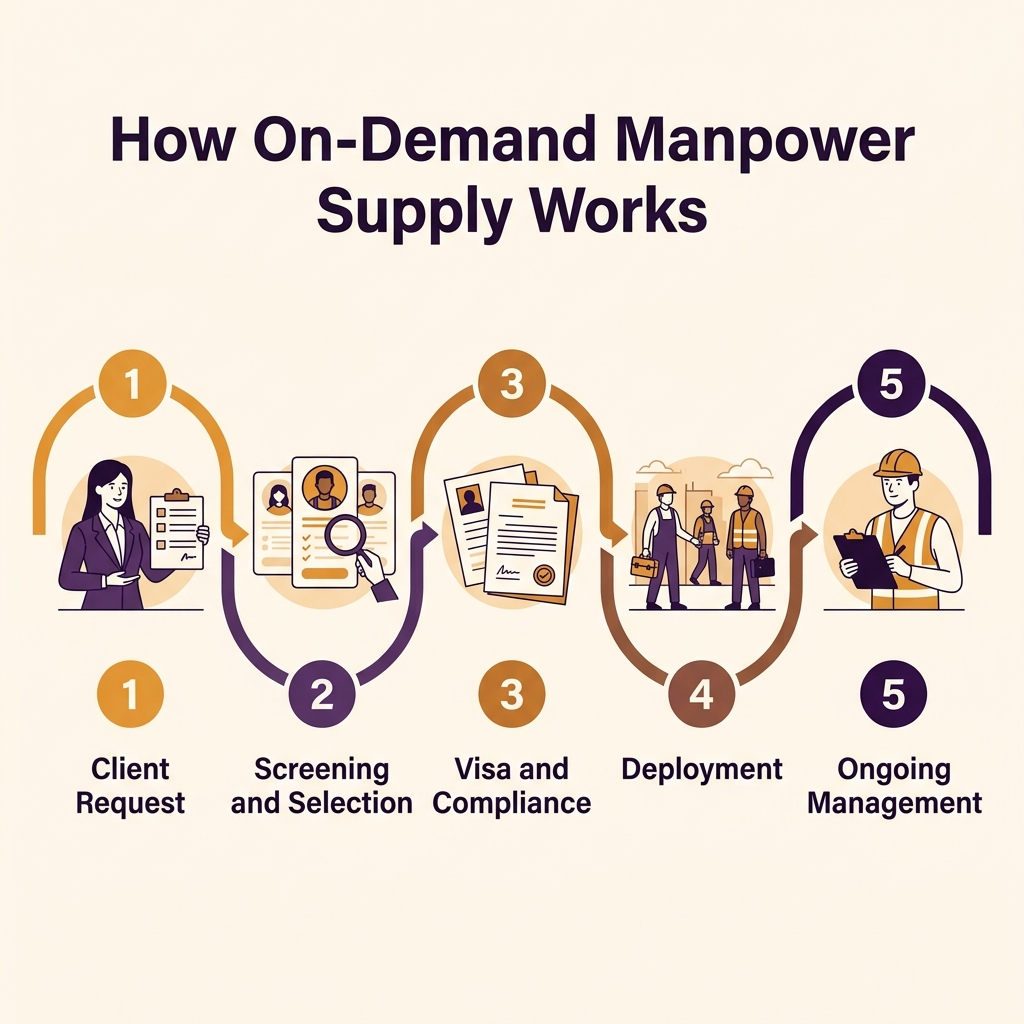
The advantage of this model is that the supplier absorbs the complexity (sourcing, screening, visas, payroll, compliance, and welfare) so your team can focus on the work itself.
Who uses manpower supply in the UAE?
Outsourced manpower is no longer a niche or stopgap measure. Across the UAE's project-driven economy, it has become a mainstream operating model. The sectors relying on it most heavily include:
- Facilities management, cleaners, supervisors, and technical staff deployed across multiple properties.
- Construction and infrastructure, skilled and unskilled labour scaled to project timelines.
- Hospitality, housekeeping, stewarding, and F&B crew that flex with occupancy and seasonality.
- Logistics and warehousing, pickers, packers, and drivers scaled for peak demand.
- Retail, merchandisers, promoters, and store staff for campaigns and seasonal peaks.
- Banking, government, and corporate, support staff, technical teams, and specialised roles.
The common thread is variable demand. When your staffing needs rise and fall with projects, seasons, or contracts, carrying a fixed in-house workforce for the peak is expensive and inflexible. Manpower supply lets you match your workforce to your actual demand.
The compliance backbone: WPS and MOHRE
In the UAE, legitimate manpower supply rests on two pillars every business should understand.
WPS (Wages Protection System) is the UAE's electronic salary-transfer system, mandated by MOHRE. It ensures workers are paid correctly and on time through approved channels. A compliant manpower supplier runs all worker salaries through WPS, protecting both the workers and your business from labour disputes and penalties. We cover how this works in detail in our guide to WPS-compliant payroll.
MOHRE licensing is what makes a manpower supplier legal in the first place. Only companies licensed for labour supply may legally employ and deploy workers to third parties. Contracting with an unlicensed supplier exposes your business to real legal and financial risk. Always confirm a supplier's licensing status before signing.
Beyond these, a responsible supplier also manages worker welfare, accommodation standards, transport, medical insurance, and adherence to rules such as the UAE midday break during summer months. These aren't just legal obligations; they're the foundation of a reliable, motivated workforce.
In-house vs outsourced: the core trade-off
The decision between building an in-house team and using outsourced manpower comes down to a few honest trade-offs:
| Factor | In-house | Outsourced manpower |
|---|---|---|
| Speed to deploy | Weeks (visa + onboarding) | Days (visa-ready pool) |
| Visa & sponsorship | Your responsibility | Supplier's responsibility |
| Payroll & WPS | You run it | Supplier runs it |
| Scaling down | Difficult, costly | Flexible, contractual |
| Admin burden | High | Low |
| Best for | Stable, core roles | Variable, non-core demand |
Most businesses land on a hybrid model, a lean in-house core for stable, strategic roles, plus outsourced manpower for variable and operational needs. We explore this decision in depth in our in-house vs outsourced comparison.
How much does it cost?
Manpower supply is typically priced per worker, using one of three models: a fixed monthly rate per head, an hourly rate, or a daily rate, often billed monthly regardless of model. The rate can bundle or separately itemise costs such as accommodation, transport, insurance, WPS processing, and visa costs, depending on what the client versus the supplier provides.
Because pricing depends heavily on role, skill level, headcount, contract length, and what's included, the honest answer is that it should be quoted per requirement rather than pulled from a rate card. We break down the cost drivers in our dedicated guide to the cost of outsourced manpower in the UAE.
How to choose a manpower supply company
Not all suppliers are equal. Before you contract, confirm:
- MOHRE licensing for labour supply, non-negotiable.
- WPS compliance. All worker wages run through the system.
- A genuine worker pool, so deployment is fast, not a scramble to recruit after you sign.
- Welfare and compliance management, accommodation, insurance, transport, and labour-law adherence handled properly.
- Transparent, itemised pricing. You should see exactly what you're paying for.
- Sector experience, a supplier who understands your industry deploys better-fit staff.
The bottom line
Manpower supply has matured from a cost-cutting tactic into a core strategy for UAE businesses navigating variable demand. Done right (with a licensed, WPS-compliant, welfare-focused partner) it gives you skilled staff on-site quickly, with the administrative and legal weight carried by someone else.
That's exactly what tamdeed is built to do: on-demand B2B manpower, supplied and managed end to end, so your workforce is never the reason a project slips.
Looking for reliable manpower in the UAE? Get in touch with tamdeed to discuss your requirements.
Frequently asked questions
What is a manpower supply company in the UAE?
A manpower supply company employs workers on its own visas and deploys them to client businesses on a contract basis. The client directs the work; the supplier handles employment, WPS payroll, visas, and welfare. This lets businesses add skilled staff without sponsoring them directly.
Is manpower supply legal in the UAE?
Yes, when provided by a company licensed by MOHRE (the Ministry of Human Resources and Emiratisation) for labour supply. Licensed suppliers ensure workers are legally employed, WPS-compliant, and covered under UAE labour law. Always confirm a supplier's licensing before contracting.
What types of workers can tamdeed supply?
tamdeed provides on-demand B2B manpower across blue- and white-collar roles (cleaners, housekeeping, supervisors, AC/HVAC/MEP technicians, electricians, plumbers, facilities and hospitality staff, warehouse and retail workers, and more) for any sector, including government, banking, and private enterprise.
How quickly can outsourced staff be deployed?
Because a manpower supplier maintains a pool of screened, visa-ready workers, deployment is far faster than direct hiring, often days rather than the weeks a visa and onboarding cycle would take. Speed depends on role, headcount, and availability.
Related insights
What a UAE Manpower Supply Agreement Should Contain
The twelve clauses that decide whether a manpower supply agreement protects you: rates, replacement, notice, WPS warranties, liability, attendance and what happens at the end.
Read article →UAE Employment Visa Process for Employers (2026)
The employer's side of a UAE employment visa: the eight steps from quota to labour card, who pays for each, how long they take, and where hires get stuck.
Read article →Maternity and Parental Leave in the UAE: The Rules
Sixty days of maternity leave, 45 on full pay and 15 on half pay, extra leave when mother or child is unwell, and five days of paid parental leave for either parent.
Read article →Looking for a reliable manpower partner?
At tamdeed, we provide compliant, high-quality managed staffing solutions across all 7 emirates of the UAE.
Get a tailored quote